

Brevard is our home, too. After the unexpected flooding, we know many of our neighbors are dealing with flood damage to driveways in Brevard County, along with cleanup and uncertainty. Our hearts are with everyone affected.
We live here and work alongside you every day. If you are dealing with damaged driveways, sidewalks, or culverts and are not sure where to start, call or text us at (321) 399-7323.
Give the water time to recede, and stay out of moving floodwater. Standing water can hide washed-out edges, open holes, and drop-offs along a driveway or swale.
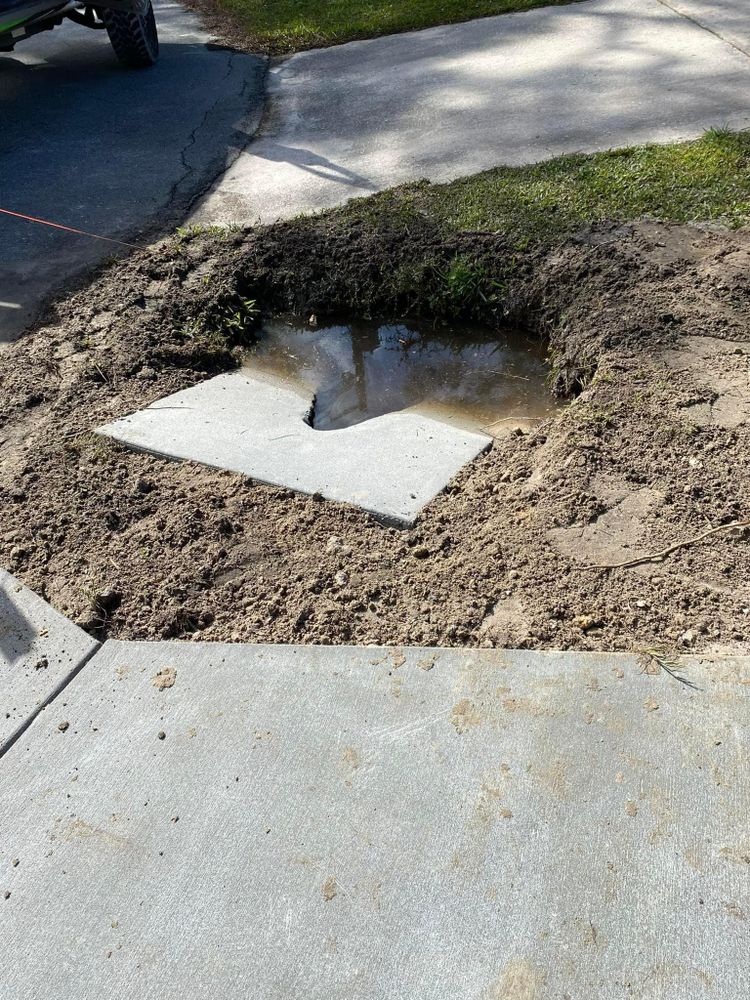
A slab can look fine on top and still have empty space underneath. If a section feels bouncy, sounds hollow, or has a washout beside it, keep people and vehicles off it until it can be checked.
Most of Brevard sits on sand. Sand drains well, but fast-moving water can carry it away from under a driveway, sidewalk, or culvert. Once that base washes out, the concrete above it has nothing solid left to sit on. That is when you see settling, new cracks, tilted panels, and edges that crumble into the swale.
Walk the property once it is safe, and look past the surface stains. Look for:
Hairline cracks are common here. Settling, a tilted panel, or a hollow sound more often mean water moved the base. See also our post on how Florida heat, rain, and storms affect concrete.
Culverts carry stormwater under a driveway so the swale can keep flowing. Floodwater can scour the soil around the pipe, shift or crack it, or wash out the apron poured over it. Check both ends from solid ground if you can do so safely. Exposed pipe, collapsed soil, a sagging section, or a broken mitered end are worth documenting.
If the driveway edge by the ditch is crumbling, a surface patch is rarely enough. The lasting fix is usually rebuilding the base, resetting or replacing the drainage pipe, and pouring new mitered ends. Work in the public right-of-way may need a permit, and rules differ in unincorporated Brevard and cities like Palm Bay or Melbourne. Check with County Public Works Engineering or your city first. If a permit is needed, our team regularly handles the paperwork.
Before you fill holes or move debris near damaged concrete, take photos and short videos. Capture:
We cannot tell you what a policy will pay, but the photos still help with an adjuster, contractor, or inspector.
It is worth a call when there is a washout or unsupported edge, a slab has settled or started to break apart, the culvert pipe is exposed, shifted, or crushed, or you want a straight answer about what you are seeing.
For local updates, start with County Emergency Management, or dial 2-1-1. For federal assistance, visit DisasterAssistance.gov or call the FEMA Helpline at 1-800-621-3362. Please check on your neighbors, too.
Ashley and Adam run Green Hammer Concrete as a family business here in Palm Bay. We will walk the property with you and talk through whether our team can help. Call or text (321) 399-7323, or request your free estimate online. Solid work. Honest results. Bringing your vision to life.

